
Events of interest
University of Western Australia (UWA): Comic Book Contracts and Other Contract Innovations
December 7–8, 2017, UWA Law School in Crawley (near Perth), Australia
Professor Camilla Andersen is organizing a two-day event, “Comic Book Contracts and Other Contract Innovations” at UWA Law School in Crawley (near Perth) on December 7–8, 2017. The event is supported by the ProActive ThinkTank, the Nordic School of Proactive Law, and the International Association for Contract and Commercial Management (IACCM). For more information, please contact Camilla Andersen, camilla.andersen@uwa.edu.au.
"The Strategy of Change: Driving Commercial Success and Improving Business Functions"
October 24 2016, San Diego, CA, USA
The conference will be held in conjunction with the 2016 IACCM Academic Forum organized by the International Association for Contract and Commercial Management (IACCM).
Like in previous years, the 2016 Academic Forum brings together professionals and academics from a variety of disciplines to provide a platform for knowledge exchange opening up possibilities for research collaboration and supporting closer ties between professionals and scholarly academics. The event will be held in association with SAGE’s Journal of Strategic Contracting and Negotiation (JSCAN) during the IACCM Americas Conference 2016 on 24–26 October.
The general theme of the Conference is transformation.
"Modern Contract Management: Integrating contract theory, law, and organization studies"
June 16 2014, Copenhagen Business School, Denmark
The conference will be held in conjunction with the 2014 joint Academic Forum organized by Copenhagen Business School and the International Association for Contract and Commercial Management (IACCM) in Copenhagen.
Like in previous years, the 2014 Academic Forum brings together contract and project management professionals and academics from a variety of legal and management disciplines. They will explore and share their insights and experience with contract design, organizational design, processes, skills, tools and techniques that help organizations to cooperate efficiently in a complex and uncertain business world. The Forum aims to provide a platform for the exchange of knowledge, open up possibilities for research collaboration and form closer ties between professionals and scholarly academics.
This year’s theme explores proattempts to apply insights from three research areas: contract theory, law, and organization studies to contract management.
"Integrating Law and Contract Management: Proactive, Preventive and Strategic Approaches"
October 8, 2013, Phoenix, Arizona
The conference will be held in conjunction with the IACCM Academic Forum in Phoenix, Arizona, and will be organized by the Proactive ThinkTank, the Nordic School of Proactive Law and the International Association for Contract and Commercial Management (IACCM).
The Academic Forum of the IACCM brings together contract and project management professionals and academics from a variety of legal and management disciplines. They will explore and share their insights and experience with the processes, skills, tools and techniques that help organizations merge proactive/preventive law with good contract, project, quality and risk management practices to achieve strategic, organizational goals through strategic contracting and their smooth, flexible implementation. The Forum aims to provide a platform for the exchange of knowledge, open up possibilities for research collaboration and form closer ties between professionals and scholarly academics.
This year’s theme explores proactive and strategic approaches to the integration of law and contract management.
The second European Proactive Law Conference "Proactive Law in a Global Business Perspective"
December 1-2, 2011, Copenhagen Business School, Denmark
The conference at Copenhagen Business School continues the series of Nordic conferences dedicated to the topic, in Helsinki, Finland (2003), Stockholm, Sweden (2005) and Turku, Finland (2007) and the First European Proactive Law Symposium held in 2009 in Nancy, France.
This year’s conference focuses on the proactive law approach in a global business perspective and looks at it through the prism of three relevant topics: international commercial litigation, new media and IT services, and proactive contracting in general.
One of the objectives of the symposium is to foster an interdisciplinary approach between proactive law and economics, as well as management, in order to further develop an economic theory of proactive law.
- Call for Papers (PDF).
- Registration.
The first European Proactive Law Symposium "Contracting and Law: Proactive and Innovative Approaches"
October 14, 2009, Nancy, France
This symposium is the first European Proactive Law symposium. It continues the series of Nordic Conferences dedicated to the topic, in Helsinki, Finland (2003), Stockholm, Sweden (2005) and in Turku, Finland (2007).
One of the objectives of this symposium is to further develop practical methods and legal theories in the emerging field of Proactive Law. It aims at being a forum for exchange between academics and practitioners.
- Call for Papers (PDF), French/English.
- Register at www.etouches.com/ICN1.
e-Stockholm '08 Legal conference
IT Regulations and Policies - from theory into practice
November 17-19, 2008, Stockholm, Sweden
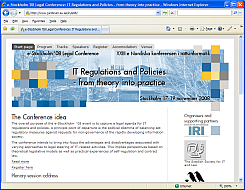
The overall purpose of the e-Stockholm ´08 event is to capture a legal agenda for IT regulations and policies. A principle point of departure is the political dilemma of balancing apt regulatory measures against requests for non-governance of the rapidly developing information society.
The conference intends to bring into focus the advantages and disadvantages associated with varying approaches to legal steering of IT-related activities. This implies perspectives based on theoretical legislative models as well as practical experiences of self-regulation and contract law.